
Most start-ups don’t need an order management system on day one. They need orders. The marketing has to work. The product has to ship. And while volume is small enough to manage by hand, a shopping cart, a spreadsheet, an accounting tool, and a home-grown database can absolutely keep the lights on. Plenty of brands have launched on exactly that stack.
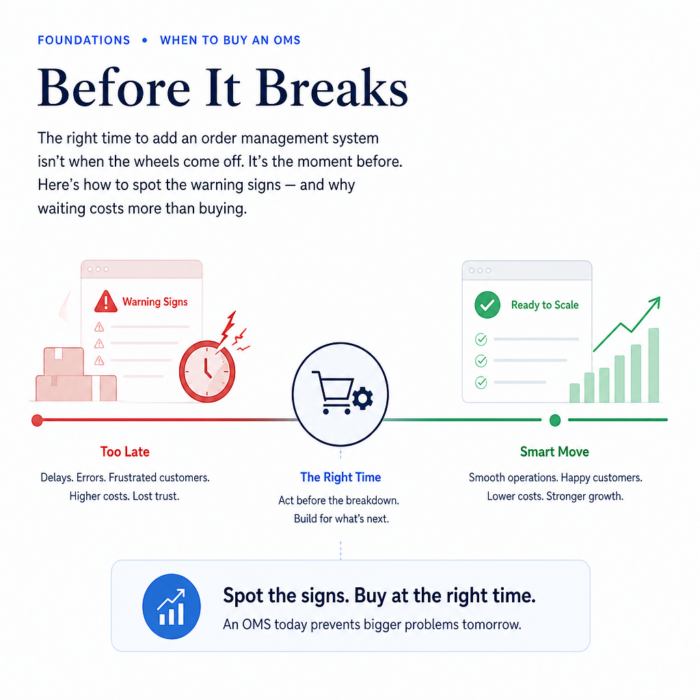
The question isn’t whether you need an OMS. It’s when. And the honest answer — the one most operators learn the hard way — is that the right time to invest is the moment before the operation can no longer absorb the next wave of growth. Wait too long, and overhead, errors, and customer service load eat the upside of the campaign that was supposed to make the year. This is the foundation article on how to spot that moment, and why buying before you need it is almost always cheaper than buying after.
How the cracks show up
The pattern is consistent across nearly every direct response and e-commerce brand that has lived through it. You’ve been processing orders through a shopping cart, sending them to an outsourced fulfillment partner, and adding customer service staff as volume grows. The system works. The math works. You decide to add another sales channel — a call center, a marketplace, a TV spot, a social acquisition push.
And then everything quietly stops working. Suddenly two, three, four payment paths are running in parallel. Customer records live in three databases. Reports come from four systems, none of which agree. Mistakes multiply. Exceptions stack up faster than the team can clear them. Instead of compounding sales and profit, the operation is compounding overhead — and the loyalty you spent acquisition dollars to build starts evaporating into refund queues and unanswered tickets.
It’s easy to defer this decision. It involves time and money you’d rather spend on the next campaign. But the right time to add an order management system is when you have a marketing hit, but before you diversify your order channels. That’s the window where the investment is cheapest and the upside is largest.
What an OMS actually does
Think of OrderLogix as the manager you wish you could clone. It’s working 24/7. It does what it’s told. And it automates the typical tasks that quietly steal hours from a growing team:
- Receives orders in real time from multiple shopping carts, call centers, IVRs, and marketplaces — into one record.
- Notifies customers automatically when their orders ship, change, or need attention.
- Tracks inventory across locations and partners, with easy package tracking and returns built in.
- Services every customer through one robust system that automates the flow of orders, payments, shipments, and reports.
- Reports on every dimension of the business — campaign performance, sales, payments, customer service, inventory, and media attribution — in one interface.
Done well, none of that is glamorous. All of it is the difference between a brand that scales and one that stalls.
Five signs you’ve outgrown your stack
If any of the following sound familiar, the math has probably already tipped in favor of investing.
1. Too many mistakes
Errors in data entry, shipping, purchasing, reporting, and accounting are quietly expensive. As a direct response, e-commerce, or catalog brand grows, complexity compounds — and so does the cost of every error. The damage isn’t always on the next P&L. Often it’s in customer reviews, repeat-purchase rates, and the slow erosion of brand trust. What you don’t know is what’s keeping you from growing.
2. Payroll is outpacing revenue
The instinct when service load grows is to hire — and the costs add up faster than most teams realize. House of Martech estimates that data silos cost the average organization $7.8 million per year in lost productivity, with 99% of executives reporting negative consequences from organizational data fragmentation.¹ That cost shows up in payroll first. When a person is the integration layer between two systems, every new channel adds a person. An OMS breaks that link.
3. You can’t keep up with demand
Timeliness is the foundation of order processing and customer service. How long does it take to process an order today? How long to respond to a “where’s my order” inquiry? Are agents spending more time chasing fulfillment status than serving new customers? With order flow automated, the conversation shifts from reacting to analyzing — and the team starts spending its hours on the questions that actually grow the business.
4. Inventory keeps surprising you
Buying too much ties up cash and risks dead stock. Running short loses revenue and customers. Both are symptoms of the same problem: not enough visibility. The IHL Group estimates that retail inventory distortion — overstocks plus stockouts — costs retailers globally $1.77 trillion a year, with stockouts alone accounting for roughly $1.2 trillion of that.² A merchant needs full visibility into stock levels and product trend history. An OMS provides exactly that, in real time, across every channel and partner.
5. Your merchant account is at risk
When fulfillment slips, when delays go uncommunicated, and when service can’t resolve issues on the first call, chargebacks rise. That isn’t just a finance problem. Visa places merchants whose chargeback ratios exceed 0.9% — and certainly above 1.8% — into its dispute monitoring programs, with escalating fines, mandatory remediation plans, and potential account termination.³ Your merchant provider also expects you to keep cardholder data encrypted, masked, and access-controlled, in line with the PCI Data Security Standard.⁴ The cost of the alternative is steep: IBM and Ponemon’s 2024 Cost of a Data Breach Report puts the global average cost of a data breach at $4.88 million, a 10% year-over-year increase.⁵ A serious OMS bakes the controls in, so compliance isn’t a separate project.
Save yourself from your own success
When you’re a start-up, you do what you have to do to get off the ground — and the cart-plus-spreadsheet stack is part of how you got here. But the operations that scale are the ones that recognize the moment when growth itself becomes the threat.
Recognizing when you need an order management system, and implementing it before the wheels come off, is one of the highest-leverage decisions a growing brand will make. The investment is almost always smaller than the team thinks. The cost of waiting almost always larger.
If any of the five signs above sound like your operation right now, schedule a personalized demo — we’ll walk through what an OMS would actually do for the way you sell today.
Sources
- ¹ House of Martech, The Cost of Inaction: What Fragmented Customer Data Actually Costs Your Business (2025). com
- ² IHL Group, Retailers and the Ghost Economy / True Cost of Out-of-Stocks and Overstocks (figures referenced through 2024). com
- ³ Visa, Visa Dispute Monitoring Program (VDMP) and Visa Fraud Monitoring Program (VFMP) thresholds, chargeback ratio rules. com
- ⁴ PCI Security Standards Council, PCI Data Security Standard (PCI DSS). org
⁵ IBM Security & Ponemon Institute, Cost of a Data Breach Report 2024. com