
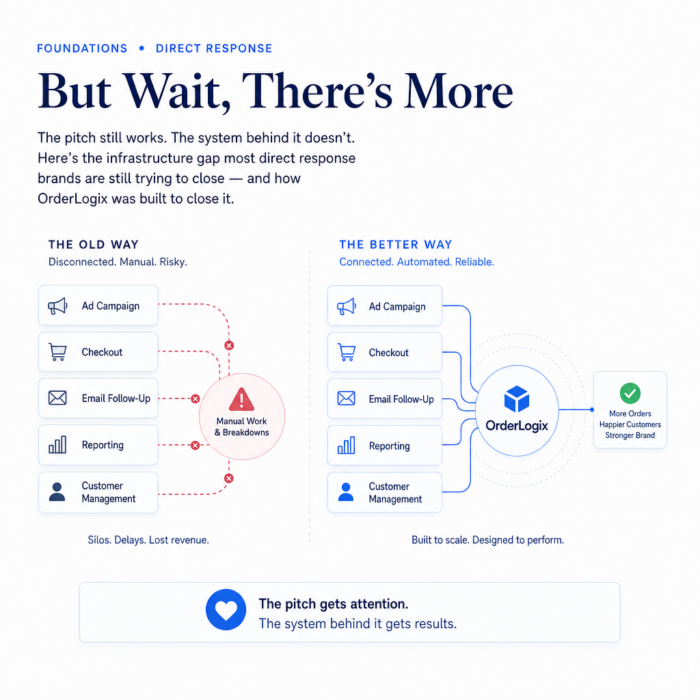
Direct response has always been unsentimental. Every 120 seconds of DRTV inventory, every inbound call, every landing-page lift, every continuity retention curve — each one is a referendum on the offer, the media plan, and the operations behind them. When the math works, you scale. When it doesn’t, you pivot. There is no middle ground.
What’s changed is where the pressure now lives. The creative still matters. The media plan still matters. But today’s DR brands compete in an environment where attribution is fragmented across more channels than ever, consumers expect instant self-service, compliance risk is rising in real time, and the bottleneck is no longer the spot — it’s the system behind the spot. Connected TV ad spend in the U.S. alone passed $30 billion in 2024 on its way toward $40 billion-plus, and that’s before counting streaming audio, podcast, addressable, and the rest of the modern DR mix.¹ An order management platform that wasn’t built for direct response will quietly tax every KPI on your dashboard. One that was built for it can be the difference between a promising campaign and a household brand.
That is the gap OrderLogix was designed to close. This is the foundation article on what that actually means.
The hidden cost of generic order management
Most commerce platforms were built for a clean retail flow: shopper browses, adds to cart, checks out, ships. Direct response rarely operates that way. DR customers arrive through short codes, vanity URLs, inbound 800 numbers, addressable TV, streaming pre-rolls, print inserts, and podcast reads. They buy continuity programs, multi-pay offers, BOGO bundles, and free-trial-to-subscription paths that change by region and by media source. They expect live agents who know the offer cold and don’t fumble a disclosure.
Generic e-commerce stacks can be bolted together to approximate that, but the seams always show. Media sources get miscoded or lost. Agents go off-script and create compliance headaches. Upsells misfire or miss the margin. Reports come from four different systems, none of which agree. Decline recovery is manual. Continuity churn hides in a spreadsheet.
The result is what most DR executives already feel: they can see the campaign performance, but they can’t act on it fast enough. They can see sales trends, but the system doesn’t surface the reason. They know a percentage of revenue is leaking through declined cards, broken upsells, and mis-attributed media — but they can’t prove which is which. OrderLogix was built with deep roots in direct response, and the difference shows up in how four capabilities fit together.
Media intelligence: the new scoreboard
In DR, media is the scoreboard. If you can’t tie a sale back to the exact spot, station, daypart, URL, or promo code that drove it, you’re optimizing in the dark. OrderLogix’s media sourcing and reporting capabilities are built into the order itself — not bolted onto the dashboard. Every order carries its attribution DNA: the source, the campaign, the agent or cart that captured it, the offer version, the upsell attach.
That data powers four decisions every DR marketer wants to make faster. Smarter allocation, because reallocating from low-ROI to high-ROI sources is the single fastest lever for revenue growth and most brands are still making the call on a weekly or monthly lag. Precise targeting, because integrated CRM and campaign tracking let you segment by audience, source, and behavior, then refine the next creative flight based on who actually converted. Faster iteration, because in DR, speed of learning is the compounding advantage — and McKinsey’s research on data-driven organizations finds they are 23 times more likely to acquire customers and 19 times more likely to be profitable.² And automation, because manual reporting and order tracking are exactly where errors and missed revenue hide.
The throughline: better data, faster, in one place — so you can redeploy spend before the window closes.
Dynamic agent scripting: compliance and conversion in one motion
Inbound call centers are still a surprisingly large slice of DR revenue, and for good reason — a well-trained agent on a well-structured script outperforms a cold landing page almost every time. The catch is that “well-structured” now has to mean compliant, personalized, and adaptive in real time. That’s a hard bar for static scripts and hard-to-scale playbooks.
The regulatory environment is also less forgiving than it used to be. The Telephone Consumer Protection Act allows statutory damages of $500 to $1,500 per violation, with class action exposure that has produced settlements in the hundreds of millions of dollars.³ “We trained them on it” is not a defense. “The script made it impossible to skip” is.
OrderLogix’s Call Center Edition treats the script as a living system. Scripts adjust dynamically based on customer responses, campaign rules, and CRM data. Required fields and disclosures are enforced at the point of the call — agents literally cannot advance without capturing them. Updates push instantly to every agent, so when the offer changes or a new compliance requirement drops, the floor is current by the next call.
The downstream effects compound. Compliance risk drops. Onboarding speeds up — new agents ramp faster when guided paths walk them through each interaction step by step. Performance visibility goes real-time, integrated directly with the phone system so managers don’t wait until tomorrow to see what worked this morning. And brand integrity is protected at the exact point most brands are quietly losing it: shift to shift, site to site, conversation to conversation.
Connected operations: the integration advantage
DR campaigns don’t live inside a single system. They live across fulfillment centers, media agencies, payment gateways, CRMs, call centers, IVRs, tax engines, carriers, and carts. The orchestration problem is often what actually separates the brand that scales from the one that stalls.
OrderLogix integrates with hundreds of partners and treats integration as a feature — not a services engagement. Orders flow from the cart or the agent desktop straight into fulfillment. Payments move through a payment orchestration layer that routes smart. Declines go into a structured decline recovery workflow instead of a retry queue that silently gives up. Reporting stays unified even when the stack doesn’t.
Two things matter here. The first is margin. Every manual handoff between systems is a place where margin leaks — in reconciliation time, in customer service tickets, in mis-shipped orders, in chargebacks. House of Martech estimates that data silos cost the average organization $7.8 million per year in lost productivity, with 99% of executives reporting negative consequences from organizational data fragmentation.⁴ The second is agility. When a new media partner, payment provider, fulfillment node, or compliance requirement enters the picture, the team with a connected platform absorbs it in days. The team without one absorbs it in quarters. In a business where offers and channels turn over constantly, that difference compounds.
Continuity, upsells, and the LTV equation
Direct response lives and dies on the gap between acquisition cost and customer lifetime value. A campaign can break even on the first order and still print money if continuity holds and upsells attach. It can also look healthy on day one and lose money by month three if involuntary churn eats the book.
OrderLogix treats LTV as an engineering problem, not a marketing aspiration. Auto-ship programs are optimized with rules, reminders, and billing logic that reduce cancellations. Multi-pay options are structured to maximize both conversion and completion. Upsells and add-ons run through the same attribution and compliance framework as the original offer, so agents and carts surface the right next step at the right time.
Decline recovery is the unsung hero of DR economics. Recurly’s research projects that failed subscription payments will cost businesses $129 billion in 2025, with involuntary churn from failed transactions accounting for 20% to 40% of all customer churn — and brands that fix it through automated recovery see a roughly 8.6% revenue lift in the first year alone.⁵ A card declining on a monthly rebill isn’t necessarily a cancellation. It’s often an expired card, a temporary hold, or a network timeout. Without orchestration, that revenue quietly disappears. With it, recovered transactions fall straight to the bottom line.
The strategic implication: stop treating acquisition, fulfillment, and retention as three separate businesses run by three separate teams. They are one business. The platform underneath them should reflect that.
Turning campaigns into brands
The best DR marketers in the world share a trait: they treat every campaign as a chance to build a brand, not just hit a CPO. The offer pays for customer acquisition. The experience, the continuity, the customer service, and the lifetime relationship pay for a business.
Getting there requires the infrastructure to match the ambition. Unified sales channels. Clean attribution. Adaptive scripts. Orchestrated payments. Automated operations. Actionable reporting. Deep vendor integrations. The ability to change an offer, a script, a media mix, or a payment path without breaking something downstream.
That’s the premise of OrderLogix: the operating system for direct response, built by people who understand that the “but wait, there’s more” mindset isn’t a gimmick. It’s a rigorous approach to testing, scaling, and compounding what works.
If you’re running a DR operation that’s outgrowing the stack that got you here, it’s worth a conversation. Request a demo or see pricing to get started.
Sources
- ¹ eMarketer / Insider Intelligence, U.S. Connected TV ad spending forecast (2024). com
- ² McKinsey Global Institute, The Age of Analytics: Competing in a Data-Driven World (data-driven organization performance multiples, widely re-cited). com
- ³ Federal Communications Commission, Telephone Consumer Protection Act statutory damages framework, 47 U.S.C. § 227. gov
- ⁴ House of Martech, The Cost of Inaction: What Fragmented Customer Data Actually Costs Your Business (2025). com
- ⁵ Recurly Research, State of Subscriptions / Churn Rate Benchmarks (2025). com
See OrderLogix in Action
Experience a live, customized demo, get answers to your specific questions, and discover why OrderLogix is the smart choice for your business.
What happens next?
✓ Personalized Consultation
A quick conversation to understand your order management goals and how your team currently handles operations.
✓ Customized Live Demo
A focused walkthrough of the OrderLogix platform, tailored to your specific workflows and challenges.
✓ Expert Support
Clear, straightforward answers to every question so you feel confident and informed.
✓ No Pressure
No obligations—just honest insights and practical guidance.
✓ Fast Launch
If you’re ready to move forward, we’ll set you up with your own multi‑channel order management system and help you get running quickly.