
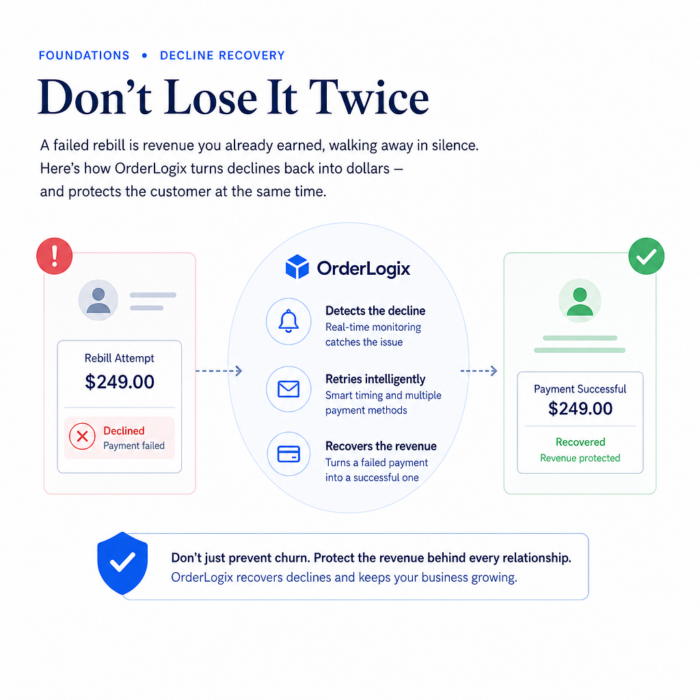
In a subscription or multi-pay business, a declined transaction is never just a payment problem. It’s revenue you already forecasted, a service relationship at risk of interruption, and a customer drifting toward an exit they never actually chose. The customer wanted the product. The offer worked. The relationship is intact. And then a card expires, an issuer soft-declines, a billing address changes — and the money quietly evaporates.
That’s the line item every direct response and continuity operator under-manages, and it’s the one with the cleanest ROI in the entire business. There’s no acquisition spend involved, no creative to test, no audience to retarget. The customer already raised their hand. Recovering the payment is just operations. Done well, it’s the highest-leverage growth lever you have. This is the foundation article: why declines compound, what OrderLogix actually does about it, and what the math looks like when recovery runs the way it should.
Why declines compound
A single declined rebill doesn’t look like much on a dashboard. The damage shows up in the ripple.
Every decline is income you forecasted but never collected — immediate revenue loss. For subscription models, a single failed renewal can cascade into months or years of forfeited future revenue, because once the relationship breaks, most customers don’t come back to fix it. Recurly’s research is direct on the scale: failed subscription payments are projected to cost businesses $129 billion in lost revenue in 2025, with involuntary churn from failed transactions accounting for 20% to 40% of total customer churn — and up to 70% of that involuntary churn driven by payment failures alone.¹
And the volume is bigger than most operators think. Industry data referenced through Visa’s recurring billing research suggests that roughly 15% of recurring transactions are declined on the first attempt — across categories, not just risky ones.² Most of those declines have nothing to do with the customer’s intent. Cards expire. Banks issue new BINs. Issuers throw soft declines on velocity rules. Customers move and forget to update their billing address. The relationship didn’t end — it just got disconnected.
The downstream cost is bigger still. Cash flow becomes harder to forecast. Inventory and growth investment decisions get fuzzier. And the customer experience itself takes the hit — service interrupts, trust erodes, even when the issue is entirely on the customer’s side. A disciplined decline recovery strategy isn’t a finance project. It’s a retention project, a CX project, and a forecasting project at the same time.
How OrderLogix recovers it
OrderLogix automates and optimizes every step of the recovery process so the work happens quietly in the background — not as a manual project on someone’s spreadsheet.
- Intelligent retries. Retries are timed strategically — not on a rigid schedule — based on decline reason, card type, and issuer behavior, so retry attempts hit when they’re most likely to clear.
- Customer notifications. Clear, branded messages guide customers to update payment information in two clicks, on any device, at any hour.
- Customizable workflows. Retry cadence, dunning windows, messaging, and escalation logic adapt to your business model — not a generic template.
- Real-time visibility. Recovery rates, decline reasons, and revenue reclaimed live in one dashboard, so the team can see exactly where the leaks are.
- Native billing and subscription integration. Purpose-built for multi-pay, continuity, and recurring revenue programs — not bolted on after the fact.
- Specialist integrations. Native integration with decline recovery specialists like FlexPay, which reports recovering 30% to 50% of declined transactions using more than 70 data points per attempt.³
Behind every retry is the same Single View of the customer that powers the rest of the platform — so a recovered payment shows up on the customer record exactly where the next agent, the next save offer, and the next reporting roll-up will see it.
Turning declines into dollars
The math on decline recovery is brutal in your favor. Consider a merchant running 200 declined transactions a month at an average of $60. At a typical baseline 10% recovery rate, that’s $1,200 a month clawed back from the decline pile. Lift the recovery rate to 30% — well within range for an automated, well-tuned program — and the merchant is now recovering $3,600 a month, an additional $2,400 over the baseline. Annualized, that’s nearly $29,000 of pure-margin revenue, with no acquisition spend attached.
Across the OrderLogix platform, the trend is consistent. Anonymized 2024 account-wide data shows an average recovery rate of 63%, with an average recovered transaction of $60. Individual results vary by business model, product mix, and customer base — but the direction doesn’t. Recurly’s benchmark research backs up the systemic ROI: brands that fix involuntary churn through automated recovery see a revenue lift of roughly 8.6% in the first year alone.⁴
Few growth levers are this cost-effective, because the customer is already yours. Acquisition spend is a sunk cost. The CAC has been paid. All that’s left is whether the operations layer is good enough to keep the relationship intact.
Beyond recovery: fraud, chargebacks, and MID health
Recovering declines is only part of the revenue protection story. OrderLogix runs the same operational discipline across the rest of the payments stack.
Fraud prevention proactively blocks high-risk BIN ranges before transactions are even attempted, so bad orders don’t pollute approval rates or chargeback ratios in the first place. Chargeback management distributes transactions across multiple Merchant IDs to preserve MID health and avoid processor penalties — a quiet but critical layer for direct response brands operating at volume. And end-to-end PCI DSS Level 1 compliance keeps customer payment data protected through every leg of the transaction.
In modern commerce, trust is the product. Secure, reliable payment handling is what turns a one-time buyer into a long-term subscriber — and what keeps the issuer relationships clean enough to support the next 12 months of growth.
Why this is the highest-ROI move in the building
Every recovered payment does more than show up on this month’s P&L. It extends the customer’s lifespan, improves subscription retention, protects recurring revenue, and lifts overall customer lifetime value. Bain & Company’s classic research found that a 5% increase in customer retention can lift profits by 25% to 95%, depending on the industry — and Harvard Business Review’s reminder that acquiring a new customer costs five to twenty-five times more than retaining one is exactly what makes decline recovery the cheapest growth lever a subscription business has.⁵ ⁶
Most of the work is invisible to the customer when it’s done well. They don’t see the retry logic. They don’t see the dunning window. They see one clear notification with a two-click update flow, their service uninterrupted, their subscription intact. That’s the point. The best decline recovery program is the one your customer never had to know about.
Quietly, in the background
OrderLogix replaces what used to be a manual, repetitive, error-prone process with an engine that recovers revenue silently while the team focuses on growth. No spreadsheets. No one-by-one retries. No chasing customers. No guessing why payments failed. Just a clean, optimized workflow that catches the leak before it becomes a churn number on next quarter’s board deck.
In direct response, every dollar of recovered revenue is a dollar earned twice — once at acquisition, once at the rebill. Don’t lose it the second time.
Want to see how much revenue you could be recovering every month? Schedule a demo with OrderLogix.
Sources
- ¹ Recurly Research, State of Subscriptions / Churn Rate Benchmarks (2025). com
- ² Visa, recurring billing transaction data referenced in industry payment recovery research; figure widely cited across subscription billing analyses (2023–2024). com
- ³ OrderLogix, OrderLogix Announces Integration with Decline Recovery Specialist FlexPay. com
- ⁴ Recurly, Churn Benchmarks Report (2025). com
- ⁵ Frederick F. Reichheld, Bain & Company, The Loyalty Effect / Prescription for Cutting Costs (foundational retention research, widely re-cited through 2024). com
- ⁶ Frederick F. Reichheld, The Value of Keeping the Right Customers, Harvard Business Review (2014). org
See OrderLogix in Action
Experience a live, customized demo, get answers to your specific questions, and discover why OrderLogix is the smart choice for your business.
What happens next?
✓ Personalized Consultation
A quick conversation to understand your order management goals and how your team currently handles operations.
✓ Customized Live Demo
A focused walkthrough of the OrderLogix platform, tailored to your specific workflows and challenges.
✓ Expert Support
Clear, straightforward answers to every question so you feel confident and informed.
✓ No Pressure
No obligations—just honest insights and practical guidance.
✓ Fast Launch
If you’re ready to move forward, we’ll set you up with your own multi‑channel order management system and help you get running quickly.